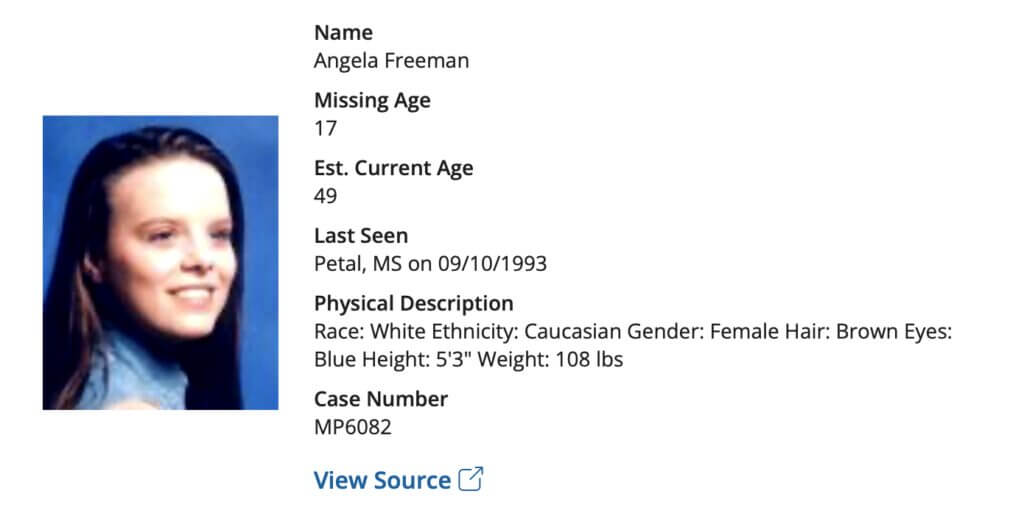
Petal, Miss. — More than 30 years after 17-year-old Angela Freeman disappeared in Petal, a new Mississippi law is altering law enforcement procedures for missing persons cases. House Bill 377, which took effect July 1, prohibits agencies from requiring a waiting period before accepting credible missing person reports and establishes new investigation protocols.
Freeman was last seen at a Pizza Hut in Petal on Sept. 10, 1993. Her case remains unsolved as the anniversary approaches, highlighting ongoing challenges in cold case investigations. Jamie Humphrey, major of operations at the Forrest County Sheriff’s Office, said the law dispels misconceptions that a waiting period is necessary before a missing person can be reported. He added that agencies can now begin investigations immediately after a report is made.
Humphrey also noted that the law prevents agencies from requiring next of kin to appear in person before an investigation starts. Deputies respond to the last known location of the missing person and assess potential circumstances, including runaway situations, kidnapping, medical emergencies, or foul play. Federal law requires law enforcement to enter information about certain missing children into the FBI’s National Crime Information Center within two hours of receiving a report, which Humphrey said helps speed up inter-agency cooperation.
Investigators examine details such as the person’s habits, relationships, and visited locations to develop a profile. Rusty Keyes, chief of police at the University of Southern Mississippi, said understanding the victim’s background is crucial. Searches often involve volunteers, community organizations, and specialized technology like drones and infrared equipment. Even after active searches end, investigations may continue for years.
Meaghan Good, founder of the Charley Project, maintains a database of cold missing person cases, emphasizing the importance of public awareness. She said accessible information can generate leads long after a disappearance. Humphrey, who began working on Freeman’s case in 2016, said advances in DNA and genetic genealogy are tools that can aid in cold cases, but traditional investigative methods remain vital.
Freeman’s family will hold a remembrance ceremony at 6 p.m. Sept. 12 at Hinton Park in Petal. For investigators and families, unresolved cases leave lasting emotional scars. Keyes and Good both expressed that the pain of long-unsolved disappearances persists, with Good noting that the emotional wounds often never fully heal.
Jon Ross Myers is the executive editor and publisher of the Mississippi News Network, Mississippi's largest digital only media company. He can be reached at editor@tippahnews.com