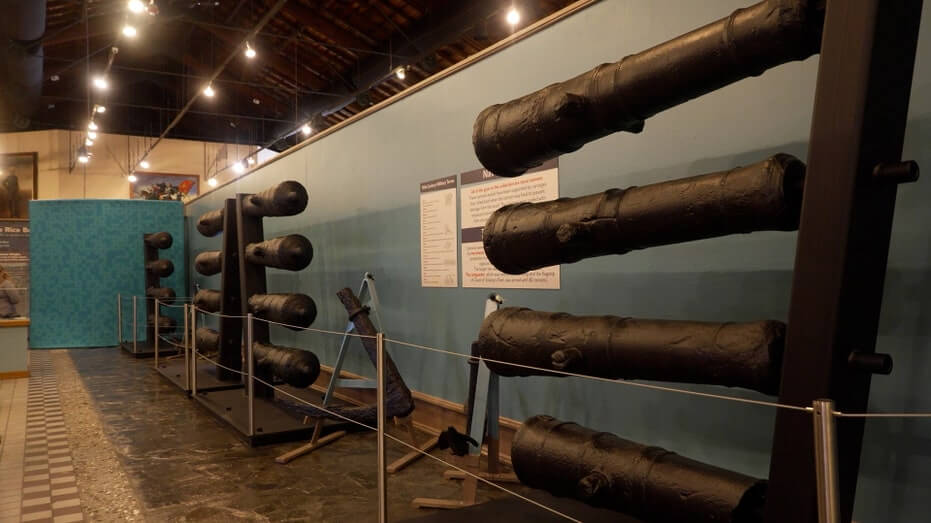
Nineteen Revolutionary War-era cannons recovered from the Savannah River were unveiled Thursday at the Savannah History Museum, museum officials said. The display opens as part of America’s 250th anniversary programming.
The cannons were discovered in 2021 when a U.S. Army Corps of Engineers crew dredged the river to accommodate larger cargo ships, museum officials said. The pieces spent nearly 240 years underwater before being pulled up, Nora Fleming Lee, CEO of the Coastal Heritage Society, said.
Fleming Lee called the find significant. “This is the largest discovery of 18th century artillery from a single Revolutionary War naval event,” she said. She said some cannons were recovered with cannonballs and gunpowder charges and that many had heavy concretion, oyster shells and other marine growth attached.
Most of the cannons left Georgia for several years for cleaning and preservation at a Texas A&M University lab, Fleming Lee said. Conservators used electrical desalination in a water bath to stabilize the iron, followed by acid treatments, waxing and other finishing work. Seventeen cannons were restored; two were left unrestored to allow visitors to compare treatment results. All 19 are on permanent display in the museum’s new “Loyalists & Liberty: Savannah in the American Revolution” exhibit, museum officials said.
Historians believe the cannons sank shortly before the 1779 siege of Savannah, when the city was under British occupation. “We believe these cannons are the last of several ships that were scuttled … to act as a blockade for the French fleet,” Fleming Lee said. The Battle of Savannah, fought on the grounds where the museum now stands, is widely regarded by historians as one of the bloodiest of the war.
The exhibit frames Savannah’s role in the nation’s founding through the perspectives of five historical figures, including Indigenous people, free and enslaved residents, women and children, museum officials said.
Jon Ross Myers is the executive editor and publisher of the Mississippi News Network, Mississippi's largest digital only media company. He can be reached at editor@tippahnews.com